
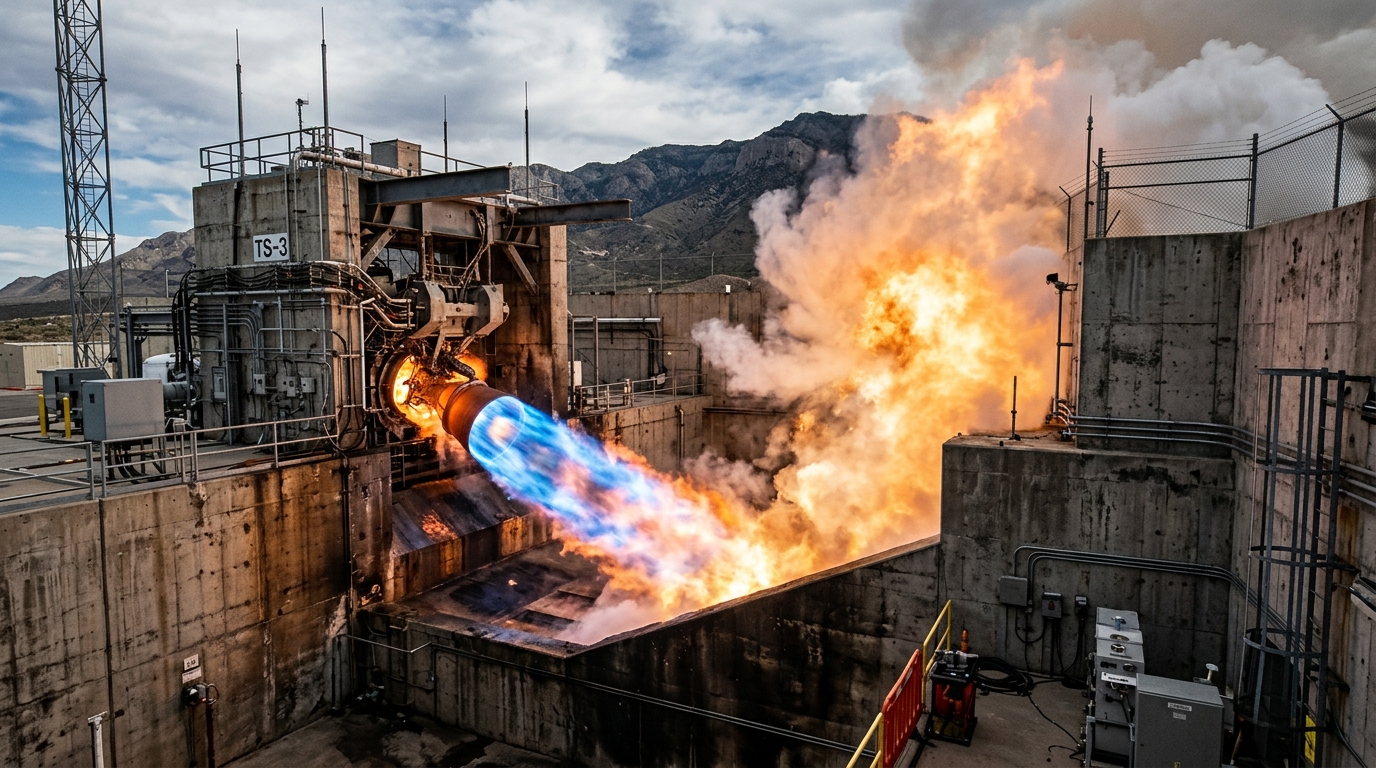
For more than half a century, liquid and solid chemical rockets have relied on deflagration—a subsonic combustion process where fuel and oxidizer mix and burn relatively slowly. However, in mid-2026, the space launch sector is undergoing a major technological leap. Rotating Detonation Rocket Engines (RDRE) have officially transitioned from experimental test facilities to operational defense and space deployment.
Supersonic Shockwaves: The Physics of Detonation
Unlike standard rocket engines, an RDRE uses **detonation**—a supersonic combustion process where a shockwave travels circularly around a ring-shaped channel (annulus) at several times the speed of sound. Fuel and oxidizer are injected continuously, feeding the shockwave and producing a continuous supersonic exhaust plume.
This radical shift in engineering unlocks massive advantages:
- 15% Fuel Efficiency Gain: By producing higher pressure inside the chamber, detonation extracts significantly more energy from the same amount of fuel (high specific impulse).
- Reduced Engine Weight: Because detonation is self-pressurizing, the combustion chamber can be smaller and lighter, drastically improving thrust-to-weight ratios.
- Simplification of Components: RDREs eliminate the need for complex, heavy turbopumps and injection manifolds, reducing potential failure points.
Comparative Performance: Traditional vs. Detonation Propulsion
| Engine Parameter | Traditional Deflagration Engine | Rotating Detonation Engine (RDRE) |
|---|---|---|
| Combustion Speed | Subsonic (Deflagration) | Supersonic (Detonation) |
| Relative Efficiency | Baseline (1.0x) | +15% efficiency gain |
| System Complexity | High (complex plumbing, manifolds) | Low (annular ring, fewer moving parts) |
| Manufacturing Method | Traditional machining & welding | 3D printing (GRCop-42 copper alloys) |
3D Printing and the Road to Commercial Orbit
The rise of RDRE in 2026 is heavily enabled by advances in additive manufacturing (3D printing). Detonation combustion chambers experience extreme thermal and pressure stresses that traditional manufacturing cannot support. Using high-strength copper alloys (like NASA-developed GRCop-42) and laser powder bed fusion, manufacturers can print complex internal cooling channels directly into the engine walls, ensuring the system can survive the continuous detonation cycle.
Future Outlook: Mars and Beyond
As space exploration targets deeper missions (such as Mars transit and lunar infrastructure), every kilogram of fuel saved translates to millions of dollars in cost reductions. Because RDREs can be configured to use liquid oxygen and liquid methane (methalox), they are ideal for future planetary missions where methane can be harvested directly from the Martian atmosphere. The next decade of space propulsion will be defined by the sound of continuous supersonic rings firing across the solar system.